
Original Balinese Life in Tenganan Village
Tenganan Village in Karangasem is one of the few remaining communities in Bali that offers an authentic glimpse into island life as it existed centuries ago, long before modern developments arrived.
The villagers of Tenganan are descendants of Bali’s original inhabitants who settled on the island long before the 15th-century arrival of Javanese settlers following the fall of the Majapahit Kingdom. Known as the “Bali Aga” or “Original Balinese,” their presence predates an exodus that marked a pivotal chapter in Bali’s history and the foundation of Balinese Hinduism. While several Bali Aga villages exist across the island, Tenganan remains among the most prominent.
Balancing Ancient Heritage with Modern Living
Tenganan is neither an isolated enclave nor disconnected from technology. Visitors will notice residents riding motorbikes through the village. Despite modern influences, Tenganan remains a close-knit community that thoughtfully welcomes progress while staying deeply committed to preserving its ancient customs.
As you enter the village, well-preserved historical homes line the pathways, and local artisans display tables featuring prasi—intricate artwork etched onto dried palm leaves depicting Hindu mythology, traditional Balinese calendars, and historical maps.
The community’s vibrant culture is evident in daily life. For instance, local gatherings at the town hall often bring residents together for cultural and religious events, such as choir rehearsals organized for regional Hindu council gatherings.
Village Layout and Traditional Architecture
Visitors enter Tenganan from its southernmost gate and walk northward along a rocky road approximately 500 meters long. The village features a distinct rectangular layout, with houses built along the eastern and western sides. As you head north, the terrain gradually steps upward like giant stairs toward the village’s highest elevation.
Situated in the wide central avenue between the residential rows are several open-air pavilions, both large and small. These structures serve as communal gathering places where villagers meet to converse, craft, or rest during the afternoon.
Traditional Crafts: Prasi, Basketry, and Geringsing
Tenganan is world-renowned for its traditional handicrafts. Alongside palm-leaf prasi art, villagers weave durable baskets, purses, and household items from grass reeds.
Most famous of all is Tenganan’s double-ikat fabric, known as Geringsing. Many homes along the main avenue display signs inviting visitors inside to purchase textiles and observe the intricate, time-honored weaving process firsthand.
The Usaba Sambah Festival
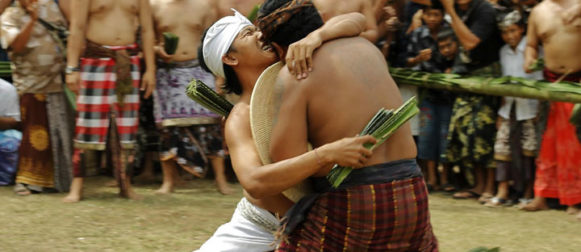
Each year, usually in May according to the Balinese lunar calendar, the village hosts the Usaba Sambah festival. A central feature of this festival is a ceremonial matchmaking duel where local men battle using thorned pandan leaves, while young women observe from a traditional wooden Ferris wheel.
How to Get to Tenganan Village
Reaching Tenganan is straightforward. Driving from Denpasar or Ubud, head east toward Padang Bai Harbor and continue along the coastal road toward Candidasa. Just before entering the main Candidasa beach strip, turn left and follow the road north to its end, where Tenganan Village is located.
Practical Travel Tips
Hiring a guide—either upon arrival or prior to your trip—is highly recommended, as the village’s rich history and oral traditions are best appreciated through local storytelling.
Candidasa, located just five minutes from Tenganan, offers a wide range of accommodation options and serves as an ideal base for exploring eastern Bali. Visitors interested in attending the Usaba Sambah festival should check with Candidasa hotels, as many offer specialized festival tour packages.

Leave a Reply